India’s EV story has always had one stubborn gap. Cars are improving, batteries are getting better, but charging infrastructure still feels patchy. Mahindra seems to be taking that problem head-on, not with announcements alone, but with a layered, long-term strategy that’s starting to take shape across highways and cities.
What’s emerging is not just a charging network. It’s an ecosystem play.
The Core Idea: Charge.IN Is More Than Just Chargers
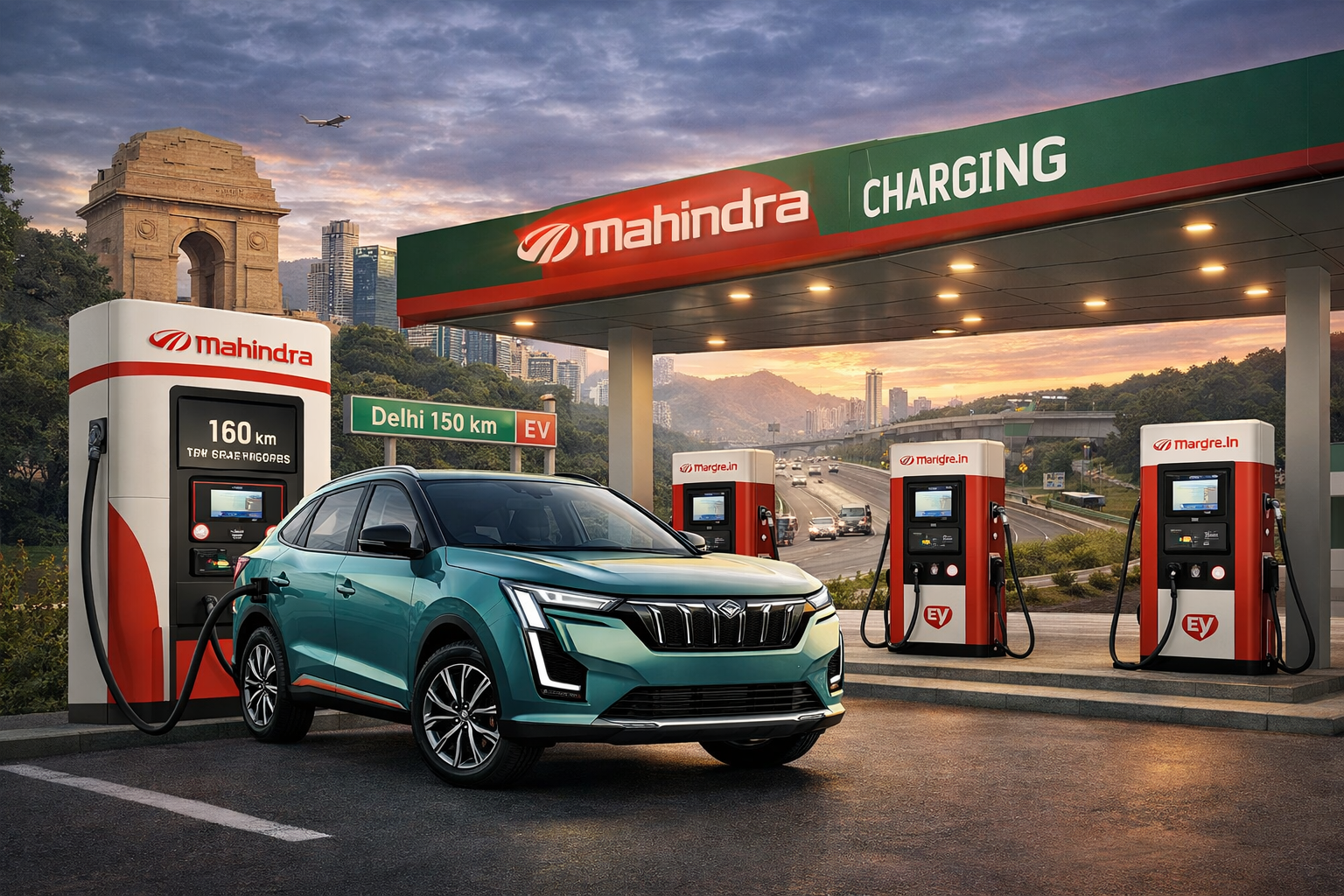
Mahindra’s EV charging initiative, branded Charge.IN, is being positioned as a nationwide, ultra-fast public charging network designed to reduce range anxiety and make EV ownership practical for daily and long-distance use.
But the interesting part is how they are building it.
Instead of slow expansion or scattered installations, Mahindra is focusing on high-power, strategically placed charging hubs that actually match modern EV capabilities.
Scale and Target: 1,000 Charging Points by 2027
Mahindra’s roadmap is ambitious but realistic:
- Around 250 charging stations planned
- Over 1,000 charging points
- All powered by 180 kW ultra-fast chargers
- Target timeline: by the end of 2027
This matters because 180 kW chargers are not entry-level infrastructure. These are high-speed DC chargers capable of significantly reducing charging time, aligning with new-generation EVs that support fast charging.
In simple terms, Mahindra is not building for today’s EVs. It’s building for the next wave.
Strategic Locations: Highways + High Traffic Urban Zones
Mahindra is not randomly placing stations. The focus is clearly on:
- National highways (intercity travel corridors)
- Fuel stations
- High footfall urban locations
The goal is obvious: enable long-distance EV travel without planning anxiety.
Some early stations are already operational on major routes like Delhi–Murthal and Bengaluru–Chennai highways, signaling a clear corridor-based approach.
This is critical because EV adoption in India has been largely city-bound. Highways are the missing link.
Big Partnership Move: HPCL Tie-Up Changes the Game
One of the biggest recent developments is Mahindra’s partnership with HPCL (Hindustan Petroleum Corporation Limited).
- Ultra-fast 180 kW dual-gun chargers will be deployed at fuel stations nationwide
- Integration with existing petrol pump infrastructure
- Faster scaling without land acquisition hurdles
This is a smart move.
Instead of building from scratch, Mahindra is piggybacking on India’s existing fuel network, which already has:
- Prime locations
- Grid connectivity
- Consumer familiarity
This could accelerate rollout far faster than standalone EV startups.
Open Network Approach: Not Just for Mahindra Cars
Unlike some early EV ecosystems that were brand-restricted, Mahindra is keeping Charge.IN open to all EV users.
- Accessible via Charge.IN app
- Also integrated with aggregator platforms
- Supports multi-brand EV charging
This is a subtle but powerful shift.
Closed ecosystems slow adoption. Open networks expand usage and improve station economics.
Tech Layer: App + Smart Charging Experience
Mahindra is not stopping at hardware. The software layer is equally important.
The Charge.IN app offers:
- Trip planning
- Charger discovery
- Slot booking
- Digital payments
This turns charging from a “hope you find one” situation into a planned, predictable experience.
Why This Matters More Than It Looks
India currently has tens of thousands of charging stations, but distribution is uneven and reliability varies.
The real issue is not just quantity. It’s:
- Charger speed
- Location strategy
- Network reliability
Mahindra’s approach targets all three.
At the same time, EV adoption in India is still low compared to total car sales, largely due to infrastructure concerns.
So whoever solves charging first gains a serious advantage.
The Bigger Strategy: Supporting Mahindra’s EV Portfolio
This charging push is not happening in isolation.
Mahindra is simultaneously launching:
- New-generation EV SUVs
- Platforms capable of 180 kW fast charging
- Long-range battery packs (500–650 km class vehicles)
This creates a closed-loop growth engine:
Better cars → Need better charging → Build charging → More people buy EVs → Network becomes viable
Competition Is Heating Up
Mahindra is not alone in this race.
- Tata is expanding mega charging hubs
- Government policies aim for dense charging coverage
- Oil companies are entering EV infra
But Mahindra’s differentiator is clear:
Focus on ultra-fast charging + strategic partnerships + open access
The Real Question: Can Execution Match Vision?
The plan is solid. The intent is clear.
But execution will decide everything.
Challenges ahead include:
- Power supply consistency
- Maintenance and uptime
- Pricing strategy
- User experience reliability
If Mahindra gets these right, it won’t just build a network. It could reshape how EVs are used in India.