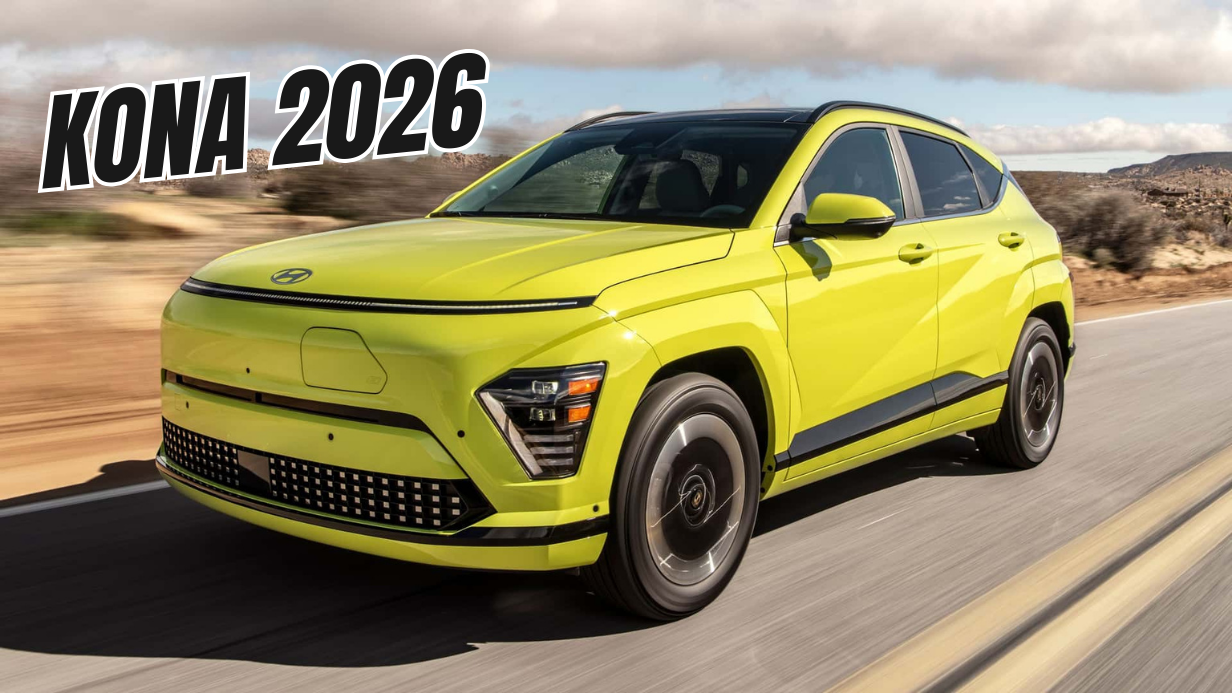
The Kona Electric was one of the first popular electric vehicles in the world. It has been modified for the middle of the 2020s to focus more on technology and software that work well with EVs. For Indian buyers, the Kona is back in the running because to its established platform, small size, and Hyundai’s service network, as long as the price, battery choice, and charging options are correct.
The official regional and worldwide pages for Hyundai reveal a completely revised Kona package for 2026. It has new digital features and better information about its range and charging times.
Hyundai Kona Electric Facelift Exterior
Compared to preceding Kona generations, the 2026 Kona Electric makeover has a sharper, more EV-focused look and tighter dimensions.
Changes that are easy to see:
Front fascia: a narrow “seamless horizon” LED DRL runs across the bonnet line (a distinctive Hyundai EV design), the lower apron has been changed, and the bumper has been cleaned up and made more aerodynamic.
Lighting: fragmented or multi-unit LED graphic elements in the DRLs and daytime running lights that stand out more.
Side profile and cladding: The waistline is a little taller, the wheels are new and better for aerodynamics, and the body cladding is more rugged, with less gentle curves.
Back: a basic tail lamp trademark with bright LED graphics and built-in diffuser parts to enhance the airflow at the back.
The new look is more EV-like, it focuses on aerodynamics and a contemporary cabin-first shape rather than strong SUV characteristics.
A few trustworthy automobile media galleries and Hyundai pages from across the world exhibit the new style and talk about how it helps with aerodynamics.
Hyundai Kona Electric Facelift Interior
Instead of showy gimmicks, Hyundai has concentrated on making its software and usability better:
Digital cockpit: a more unified dual-screen arrangement with a bigger driver display and an infotainment screen that offers connected-car services and updates over the air. Official Hyundai webpages promote the Connected Car Navigation Cockpit and OTA features of Hyundai cars. Expect to be able to navigate on board using real-time maps of charging stations.
Materials and layout: improved seat upholstery choices, more soft-touch plastics, and a center console that is easier to use with fewer physical buttons (more haptic controls).
Useful features include wireless phone charging, several USB-C connections, a bigger glovebox, and smart storage bins. Some markets offer ventilated seats and a large sunroof as extras.
Safety / ADAS: Level 2 driver assistance package with adaptive cruise control, lane keeping, blind spot monitoring, and rear cross-traffic warning. You should expect camera and radar combinations as well as calibrations that are customized to each location.
In short, the cabin is now more like recent Hyundai EVs, which focus on software and linked services instead of just luxury.
Power, Battery & Range
The Kona Electric has been available with two primary battery options in recent updates: a smaller battery (39–48 kWh) for city drivers and a bigger battery (64–69 kWh) for longer ranges and more power.
Motor outputs usually range from around 100 kW (about 135 bhp) to about 150 kW (about 200 bhp) with the larger battery. The claimed ranges change depending on the test cycles (WLTP, EPA, NEDC).
Important points and sources:
International standards provide battery and range options and say that some configurations (top-range, lighter EU spec) can go up to about 500 km WLTP. It depends on the real world.
Hyundai has typically introduced the Kona in India with a lesser battery than the highest international versions. Pages on the Indian market and local vehicle websites say that battery alternatives for India are usually the lowest in worldwide ranges.
Hyundai India will probably start with one or two trims, probably a ~39–48 kWh pack for city driving and maybe the bigger battery in a luxury version if Hyundai wants to make Kona the top EV in India.
Charging
AC charging: Most trims come with a 7–11 kW inbuilt AC charger that works while you sleep or at home.
DC fast charging can reach up to 100 kW in some markets with greater battery packs. Smaller packs can only allow lower peak charging speeds.
Charging periods will be different in real life. A common estimate is that bigger packs will charge 10–80% in around 30–50 minutes on the right fast-chargers. Smaller packs would charge considerably more slowly.
Real-world range & what to expect in Indian conditions
The WLTP/EPA/NEDC values that manufacturers give out don’t always match up perfectly with Indian city/highway mixtures. Setting reasonable expectations:
Driving solely in the city with the AC on: the smaller ~40–48 kWh pack may get you 200–300 km in the real world, depending on how much AC you use, how much traffic there is, and how you drive.
Highway and mixed driving: the bigger pack (around 64 kWh) may potentially provide you 300 to 400 km on mixed roads, although hot weather and fast speeds will make it less efficient.
Season and weather: Using a lot of air conditioning in the heat lowers the range, which is a big problem in most Indian cities.
Keep in mind that the range would rely a lot on which battery India gets. In the past, Hyundai has typically sent a smaller pack first to keep prices down.
Expected India launch timeline & pricing
There are different reports from throughout the world concerning the Kona’s future cadence. certain sources say that manufacturing has stopped or that the model year has been skipped. In certain areas, Hyundai’s regional product pages show revised specs for the 2026 Kona Electric. This makes it hard to tell when India will happen.
Realistic price bands to expect at launch (educated guess):
- Base / city pack (smaller battery): ₹23–27 lakh ex-showroom (value city EV option)
- Mid / long range pack: ₹28–33 lakh ex-showroom (if Hyundai decides to bring the larger battery)
- Top / tech loaded: ₹33 lakh+ (if imported or higher equipment)
Notes:
These prices assume a partly localized supply (CKD) or aggressive pricing strategy. Full CBU imports would push prices significantly higher.
Government subsidies, state incentives and local EV policies (road tax exemptions in many states) could lower on-road costs materially; check state incentives before purchase.
Ownership costs, service & battery warranty
Service network: Hyundai has one of the largest networks of dealers and service centers in India. This is a good thing for EV owners who may require help from a dealer with software upgrades, warranty work, or regular maintenance.
Battery warranty: Hyundai should give a battery guarantee that is normal in the industry (like 8 years or 1.6 lakh kilometers). Check the final India brochure for the specific details.
Cost of running: Electricity is cheaper than gas or diesel, and EVs usually need less maintenance since they have fewer moving parts. However, battery health and how well they charge quickly will affect long-term expenses.
Long-term value & resale: what to expect
In India, it’s usually easy to sell a Hyundai brand car. But the resale market for EVs is still growing, and battery health and warranty transferability are important.
Software and connectivity: automobiles that get regular OTA updates are more desirable. Check Hyundai India’s OTA policy for the Kona.
Kona Electric vs Key Rivals (India Comparison)
| Feature | Hyundai Kona Electric | MG ZS EV | Tata Nexon EV |
|---|---|---|---|
| Max Range (Claimed) | Up to 500 km (global) | 461 km | 465 km (LR) |
| Battery Options | 2 (Global) | 1 | 2 |
| Power | Up to 204 PS | 176 PS | 145 PS |
| ADAS | Yes (Expected) | Yes | Limited |
| Expected Price | ₹23–33 lakh | ₹18–25 lakh | ₹14–20 lakh |
| Brand Network | Very Strong | Growing | Very Strong |
| Premium Feel | High | High | Moderate |
Ownership Cost Estimate (5 Years Approx)
| Expense Type | Estimated Cost (₹) |
|---|---|
| Electricity (Annual ~12,000 km) | 18,000–25,000 |
| Service & Maintenance (Annual Avg) | 8,000–12,000 |
| Insurance (Annual) | 55,000–75,000 |
| Battery Warranty | 8 Years / 1.6 lakh km (Expected) |
| Total 5-Year Running Cost | ~₹3–4 lakh (approx) |