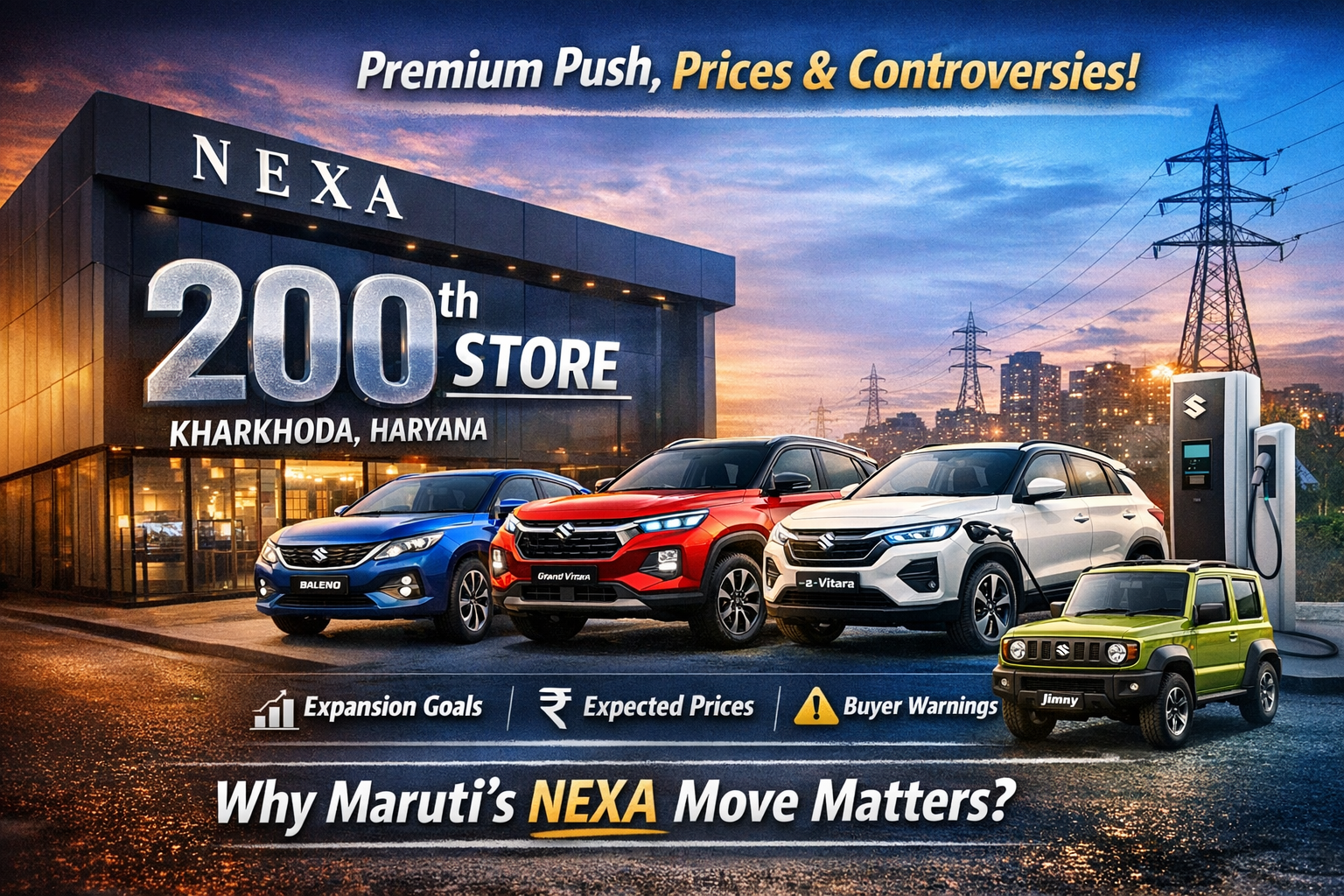
Maruti Suzuki officially established its 200th NEXA Studio store. This is a big step in the brand’s aim to bring its high-end retail channel to more rural towns and semi-urban areas in India. So let why, how, and what of everything from corporate strategy and customer experience to the prices you may anticipate to pay for popular NEXA devices and the controversies you should be aware of. The key information and data below come from Maruti Suzuki’s release and major Indian motor magazines.
Why Maruti NEXA’s 200th Store Matters : The Strategy, Growth Story and What It Means for Indian Buyers
1. Premiumisation + volume: “Sell up, without losing reach”
Maruti has two goals at the same time: to keep dominating the market for cheap cars and to get people to buy more expensive, higher-margin cars. NEXA is the vehicle for premiumisation; Studios let Maruti reach customers who previously bought through mass channels but are now aspirational, they want better machines and experiences but live outside big cities.
2. Faster geographic reach with lower cost
Studios are cheaper to set up than full showrooms and quicker to launch. This enables Maruti quickly reach a lot of towns. The company already has 740 NEXA stores in about 530 locations, and the 200 Studio milestone shows that the approach works on a larger scale.
3. EV and future-readiness at the local level
As electric cars like the e-Vitara and e-Vitara join the NEXA line-up, Maruti requires local points of contact to teach customers about the cars, answer questions about charging, and establish trust. Studios are like neighborhood ambassadors for new technologies and services. (See pricing/ownership caveats for e-Vitara later.)
4. Strategic proximity to manufacturing
Opening a studio near Kharkhoda (where Maruti makes things) shows that the company is working together better. Logistics, test drives, and supplies can all be made easier, and dealers can better justify their investments near production hubs.
Growth targets, contribution to volumes, and timeline
By FY 2030–31, Maruti wants to have 600–700 NEXA Studio stores open. This is part of a long-term plan to establish NEXA a fully nationwide premium retail channel. Industry reporting also notes that NEXA Studios could make up 25–30% of NEXA’s sales mix over time, although today they contribute a smaller share (reported variably around 8–10% currently in some summaries).
Why the range? Early-stage formats usually take a long time to grow, and demand varies by region. Maruti’s plan is very ambitious because India’s Tier-II/III market is big and growing. The company is using dealer partners to reach these goals.
Why semi-urban & rural India matters now
Rising purchasing power: Semi-urban and rural India has seen rising incomes and aspirations; these are buyers who increasingly want feature-rich, safer, better-styled cars. Maruti says that a lot of its sales come from rural areas and small towns. In fact, some reports say that rural India currently makes up more than 50% of Maruti’s sales. That’s a big motivation to offer premium experiences outside of big cities.
Urban markets saturating: Major cities are getting close to saturation for first-time automobile buyers, thus growth is coming from smaller towns and people who are updating their current cars. NEXA Studios wants to get those people who are upgrading.
Preparing for EVs and teaching customers: Electric vehicles need greater dealer engagement (charging, warranty, and battery policy clarity). Being present in smaller communities makes it easier for first-time EV buyers.
Models available via NEXA (popular ones) and expected price ranges
Here are some NEXA vehicles that are often sold and their pricing ranges (ex-showroom / average on-road estimates as of February 2026). Prices vary by city, model, and deals; see below for examples:
The price of the Maruti Grand Vitara starts at about ₹10.76 lakh for the base model and goes up from there (on-road prices vary by city). For NEXA customers, the Grand Vitara is a very important mid-size SUV.
The Maruti e-Vitara (electric SUV) starts at roughly ₹13.49–13.99 lakh (depending on the version) and goes up to around ₹16 lakh on the road. For some trims, Maruti has also used battery rental or subscription plans (there have been controversies about battery subscription and rental plans). Check with the dealer in your area to get the most up-to-date information on costs and battery plan options.
Maruti Baleno: ex-showroom range roughly ₹5.99 lakh to ~₹9.10 lakh depending on variant, a core premium hatchback in NEXA.
The Maruti Fronx is a high-end crossover/hatchback model produced under the NEXA brand. Prices vary by variant, so check local listings for the actual numbers. It usually falls between the Baleno and Grand Vitara price bands.
If you can buy a Maruti Jimny through NEXA in your location, it will be a luxury compact 4×4 with a higher price because it is rare and only available in certain areas.
Important: These prices are just estimates based on dealer listings and price aggregators. Always check with your nearest NEXA/NEXA Studio for estimates on the road, dealer deals, exchange bonuses, and any state-specific incentives.
How NEXA Studio changes the buying experience for local buyers
Convenience and a high-end vibe: Buyers can obtain a high-end showroom feel close to home without having to go to a city. Test drives, financing, and servicing appointments are all closer to home.
Service & spares locally: Studios often offer sales + service + spares, which reduces downtime and builds trust.
Sales staff trained to NEXA standards: Presentation and sales process are tailored for premium buyers (appointment-based experiences, demos, feature walkthroughs).
For EVs like the e-Vitara, Studios can illustrate how to charge them, talk about battery options, and discuss the price of owning one for a long time.
How this affects competition (Hyundai, Tata, Kia, etc.)
Maruti’s NEXA Studio campaign puts pressure on its competitors to open more dealerships in smaller towns. Hyundai, Tata, Kia, and others already have sound plans for small cities. Maruti’s rapid deployment of Studio will likely lead to more competition and marketing spending in semi-urban India, which is good for customers because they will have more options and better deals. Maruti’s strengths are its size, countrywide service network, and large range of models.
Which customer should consider NEXA cars & NEXA
First-time premium buyer: If you reside in a Tier-II town and are moving from a hatchback to a small SUV or premium hatch, a NEXA Studio brings the showroom experience to you.
If you’re interested in buying an electric vehicle in a small town, the e-Vitara at a local NEXA Studio makes it easier to switch to an electric vehicle. You can ask about charging and battery plans right there.
Family buyers who care about value: The Baleno and Fronx models are good examples of how to get a lot of features for a low price.