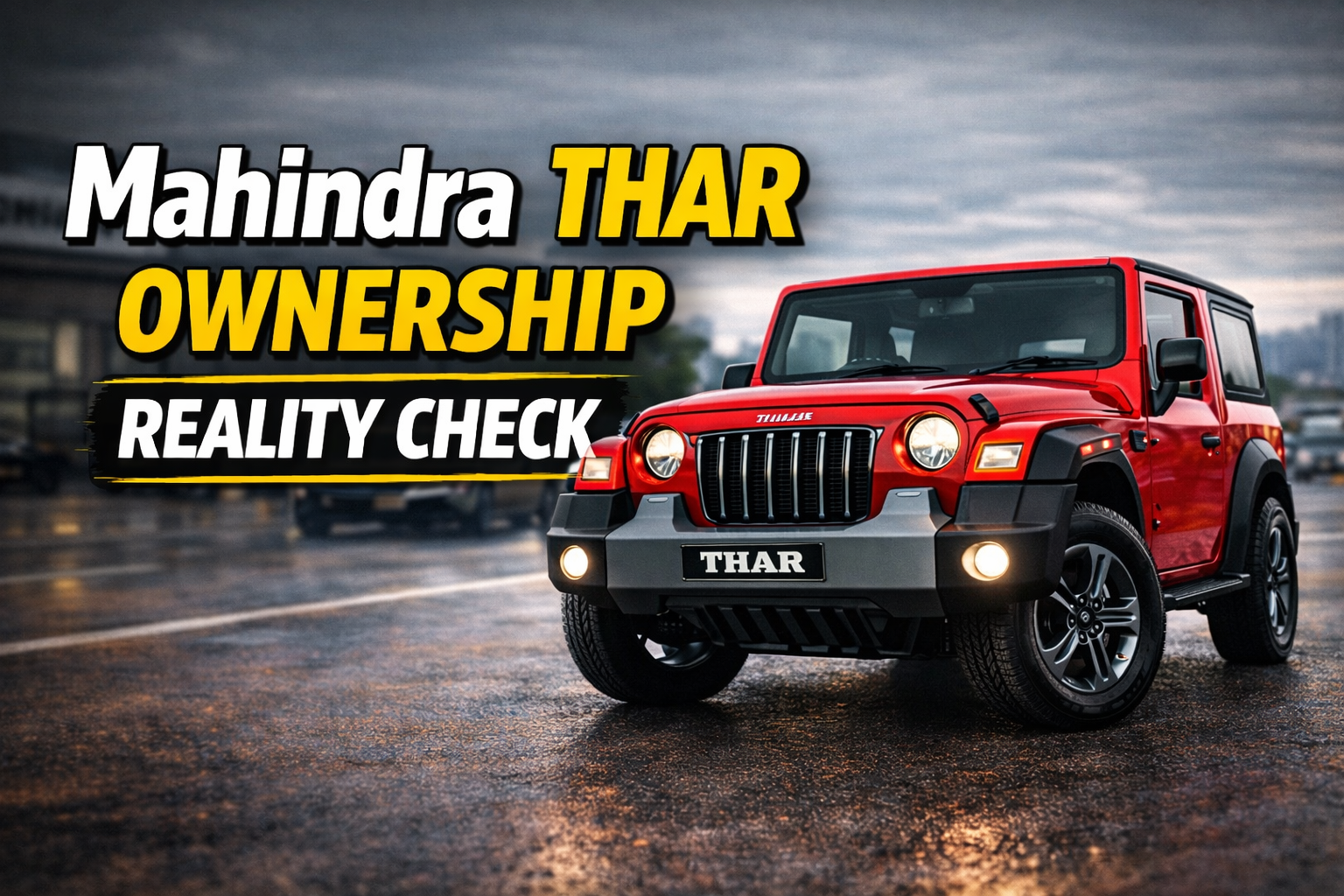
The Mahindra Thar is easily one of the most exciting SUVs on Indian roads today. But after the excitement of the first few months fades, many owners begin noticing everyday compromises such as rear seat access difficulties, bouncy ride quality in the city and higher fuel consumption compared to regular SUVs.
The first few weeks are filled with excitement. People notice the car in traffic, friends want to take photos with it and every drive feels special.
However, once the Thar becomes part of daily life, commuting, traffic jams, parking struggles and long drives, owners start understanding both the strengths and the compromises that come with this iconic SUV.
First 3 Months: The Thrill of Owning a Thar
For most owners, the first few months are incredibly exciting.
Driving a Thar feels very different from driving a regular SUV. The tall stance, large wheels and boxy design give the vehicle a strong presence on the road.
One of the first things new owners appreciate is the high driving position. Sitting above most cars gives excellent visibility, which makes drivers feel confident even in busy traffic.
The diesel engine also impresses many buyers early on. The strong torque makes the Thar feel powerful during acceleration, especially when climbing slopes or driving on highways.
During this phase, owners typically love:
- the rugged design
- the commanding road presence
- the feeling of driving a true off-road machine
- the powerful diesel engine
Many new owners also take their Thar on short road trips just to experience the vehicle outside city traffic.
At this stage, the Thar feels like the perfect adventure SUV.
2 – 3 to 6 Months: Everyday Driving Reality
After a few months, owners begin using the Thar for normal daily tasks — commuting to work, grocery runs and city driving.
This is when the SUV’s off-road DNA becomes more noticeable.
The suspension setup that works brilliantly on rough terrain can feel slightly stiff and bouncy on certain city roads. At lower speeds, passengers sometimes notice the body movement more than in typical monocoque SUVs.
Fuel efficiency also becomes clearer during this stage.
Real-world owner reports usually look like this:
| Driving Situation | Real Mileage |
|---|---|
| Heavy city traffic | 9–11 km/l |
| Mixed driving | 11–13 km/l |
| Highway cruising | 13–15 km/l |
These numbers are reasonable for a large 4×4 SUV, but buyers moving from smaller cars sometimes find the mileage lower than expected.
Still, most Thar owners accept this trade-off because the vehicle is designed primarily for capability rather than efficiency.
3 – 6 to 12 Months: Practicality Questions
Once the Thar has been used for several months, owners begin noticing the practical limitations that come with its three-door layout.
The biggest issue frequently mentioned is rear seat access.
Since the Thar only has two doors, passengers entering the back must fold the front seats forward. For younger passengers this may not be a problem, but older family members can find it inconvenient.
Boot space is another area where compromises become evident. The rear storage area is smaller than many compact SUVs, which means long family trips require careful packing.
Highway refinement is another topic that appears in owner discussions.
At higher speeds, wind noise around the roof and doors becomes noticeable. This is common for ladder-frame SUVs with upright designs, but buyers transitioning from hatchbacks or crossovers sometimes find it surprising.
These limitations are not flaws.. they are simply part of the design philosophy of a hardcore off-road vehicle.
4 – 12 to 18 Months: Living With the Thar
After a year of ownership, most drivers develop a deeper appreciation for what the Thar does well.
One of the biggest positives is durability.
The ladder-frame chassis and strong suspension setup allow the vehicle to handle rough roads without much trouble. Owners who frequently travel on broken highways or rural roads say the Thar feels extremely robust.
Maintenance costs are also fairly reasonable for an SUV of this type.
Typical ownership expenses include:
| Service Item | Approx Cost |
|---|---|
| Regular service | ₹7,000 – ₹10,000 |
| Brake pads | ₹3,000 – ₹5,000 |
| Battery replacement | ₹6,000 – ₹8,000 |
Another thing many owners enjoy is the community around the Thar. Owner clubs regularly organize off-road drives and road trips, which makes the vehicle feel like part of a lifestyle rather than just a car.
Common Mahindra Thar Owner Complaints
| Owner Complaint | % of Owners Reporting | Severity |
|---|---|---|
| Difficult rear seat access | 44% | Medium |
| Lower fuel efficiency in city | 40% | Medium |
| Bouncy ride on uneven roads | 35% | Medium |
| Limited boot space | 30% | Low |
| Wind noise at highway speed | 26% | Low |
| Parking challenges in tight areas | 22% | Low |
Most of these are design compromises rather than reliability issues.
10 Things Mahindra Thar Owners Realize Only After Buying It
- The Thar attracts attention everywhere.
- Off-road capability is genuinely impressive.
- Rear seat access can be inconvenient.
- Fuel consumption is higher than smaller SUVs.
- Parking requires more effort in crowded cities.
- The diesel engine delivers excellent torque.
- Highway wind noise is noticeable.
- Boot space is limited for family trips.
- The suspension handles rough terrain brilliantly.
- Owning a Thar often leads to more road trips.
What Owners Say After 50,000 km
Drivers who have spent years with the Thar usually report strong reliability.
The diesel engine continues to perform smoothly, and the ladder-frame construction keeps the vehicle feeling solid even after heavy use.
Some suspension components may require replacement after extensive off-road driving, but this is expected in vehicles used for tough terrain.
Overall, the Thar is considered a durable SUV capable of handling demanding driving conditions.
What Owners Still Love About the Thar
Despite the compromises, most Thar owners remain extremely enthusiastic about their vehicles.
Key highlights include:
- unmatched road presence
- powerful diesel engine torque
- exceptional off-road capability
- rugged build quality
- unique driving experience
For many buyers, these strengths easily outweigh the practical limitations.