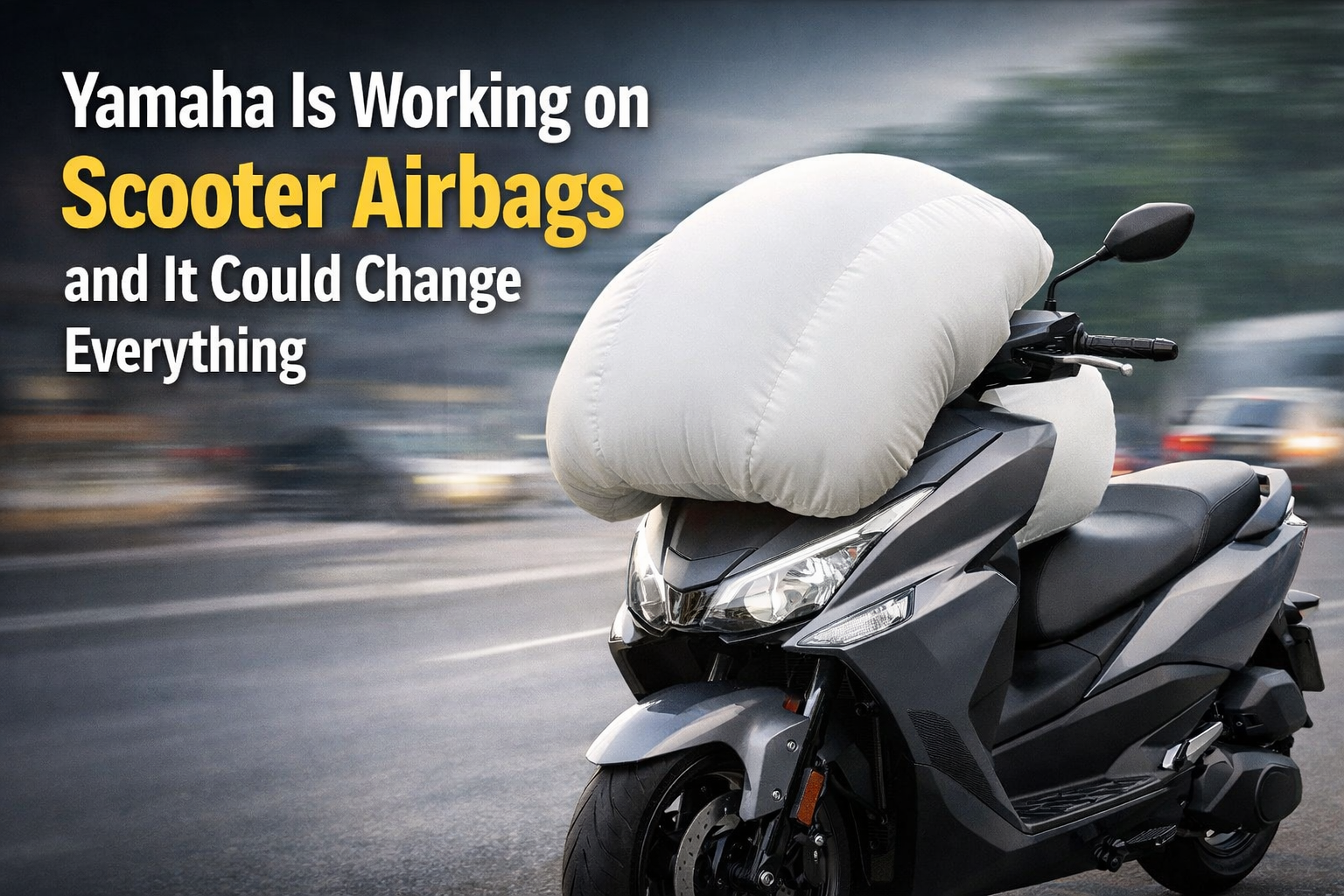
Yamaha is working on an airbag system for scooters, and honestly, it feels like something that should have happened years ago.
If this actually reaches production, daily commuting on Indian roads might finally feel a little less like a survival game.
When Scooters Stop Being “Just Scooters”
There is a strange truth about scooters in India. People rely on them for everything, office runs, grocery trips, late night chai rides, and even emotional breakdown drives when life feels off track, but when it comes to safety, expectations have always been surprisingly low. You get mileage, you get storage, maybe some styling if you are lucky, but real safety innovation has always stayed somewhere in the background. Yamaha seems to be quietly questioning that mindset, and this airbag system is proof that they are not just building machines anymore, they are thinking about the human sitting on it.
The idea itself feels almost obvious once you hear it. Cars have airbags, premium bikes have started experimenting with them, so why not scooters that carry millions of riders every single day. But then reality kicks in. Scooters are compact, lightweight, and not exactly built to hide complex systems inside them. That is where Yamaha’s engineering challenge begins, because this is not about copying car technology and shrinking it down, this is about reinventing it entirely for a completely different format.
How This Airbag System Might Actually Work
From what is being explored, Yamaha’s system will not just be a simple cushion waiting to pop out. It is expected to be a tightly integrated setup of sensors, motion detection logic, and extremely fast deployment mechanics that react within milliseconds. The moment the system detects a serious frontal impact, the airbag could deploy from the front section of the scooter and create a protective barrier between the rider and whatever they are about to collide with.
Now imagine that moment in real life. A sudden brake, a car cutting lanes without warning, or a slippery patch during monsoon. These are not rare situations, they are everyday realities. In most of these cases, the rider’s upper body takes the worst hit. Helmets save lives, no doubt, but they cannot protect your chest or torso. That is exactly the gap Yamaha is trying to fill, and if they get it right, this could reduce serious injuries in ways we have not seen before in the scooter segment.
The Engineering Headache Behind the Idea
This is where things get interesting, and slightly frustrating if you think like an engineer. Scooters do not offer the luxury of space like cars do. There is no dashboard cavity, no large frame sections to hide components, and every added gram affects balance and efficiency. So Yamaha has to design something that is compact, lightweight, reliable, and smart enough to not misfire.
Because let’s be honest, an airbag deploying at the wrong time would not just be awkward, it could be dangerous. Imagine it going off because of a pothole or a hard brake in traffic. That is not innovation, that is chaos. So the system has to be incredibly precise, reacting only when it truly matters. This is where Yamaha’s experience and patience will be tested the most.
This Is Not Yamaha’s First Rodeo
Interestingly, the concept of airbags in two-wheelers is not entirely new. The Honda Gold Wing has already shown that it is possible to integrate such systems into motorcycles. But that is a luxury touring machine, big, expensive, and designed with space to accommodate advanced tech. Scooters are a completely different story. They are practical, affordable, and built for mass usage.
Bringing airbag technology into this segment is like taking something from a business class flight and trying to fit it into a crowded metro coach without making it uncomfortable or expensive. That is the level of balance Yamaha needs to achieve.
What This Means for Indian Riders
For riders in India, this could quietly become one of the most important upgrades in years. Roads here are unpredictable, traffic behavior is often chaotic, and two-wheelers remain the most vulnerable vehicles in most accident scenarios. Adding an airbag does not make riding risk free, but it definitely adds a layer of protection that has been missing for decades.
There is also a psychological shift that comes with it. When manufacturers start focusing on safety at this level, riders begin to expect more. Suddenly, features like ABS are no longer “premium”, they become basic. The same could happen with airbags in the long run, and that shift could push the entire industry forward.
The Domino Effect on the Industry
Once a brand like Yamaha starts working seriously on something like this, competitors do not sit quietly. They observe, they test, and eventually, they respond. That is how features evolve from rare innovations to standard expectations. We saw this with disc brakes, we saw it with ABS, and we might soon see it with airbags.
It will not happen overnight, and it will not be cheap in the beginning, but the direction is what matters. And right now, the direction clearly points toward safer two-wheelers.
So When Will You Actually See This on the Road
This is the part where patience comes in. Safety systems cannot afford trial and error in public. Yamaha will need extensive testing, real world simulations, and probably years of refinement before this becomes production ready. Regulations will also play a role, especially in markets like India where cost sensitivity is high.
But the fact that development is already happening tells you something important. This is not a distant dream anymore, it is a work in progress.
Final Thoughts, From One Rider to Another
There is something quietly reassuring about this whole development. Not flashy, not loud, just meaningful. Because at the end of the day, riding is not just about speed or style, it is about getting home safely. Yamaha working on an airbag system for scooters feels like a step in that direction, a step that respects the rider rather than just selling to them.
And if this actually makes it to production, the next time you twist the throttle and head into unpredictable traffic, you might carry something more than just confidence. You might carry a little extra protection, the kind that actually matters when things go wrong.